
Who this article is for:
- Process and maintenance engineers in plants producing medium- and high-viscosity products: food, cosmetics, chemicals, oils and pet food.
- Production and technical directors looking for ways to reduce product losses and shorten changeovers.
- Investors and project managers planning to upgrade or build a process installation.
- Quality and health and safety teams dealing with the risk of cross-contamination and workers’ exposure to cleaning chemicals.
What you will learn from this article:
- How a pigging system works and what a pig is.
- What specific benefits pigging delivers: economic, environmental, process and quality-related.
- In which industries and processes this technology works best.
- How to integrate the system at the inlet (launch station, valves, valve matrix) and at the outlet (receiving station, filler, signals to the PLC).
- Which technical details to pay attention to for a successful implementation: pig material, pipeline geometry, welds, tees and pressure safety.
Why we wrote this article:
Many plants still flush valuable product down the drain because they treat pipeline losses as an unavoidable cost of production. Pigging is a proven solution to this problem, but its results depend on whether it is designed as an integral part of the installation rather than added on as a “bolt-on”. This article aims to help you assess whether this technology makes sense for your plant and to show what needs to be considered at the design stage so that the investment genuinely improves your bottom line.

He has been delivering investment projects in the process industry for 20 years. He has followed the full engineering career path: from designing installations, through managing projects as a Project Manager, to building project delivery structures as Technical Director and co-founder of WiZARTEC®.
He currently heads the Proposals Department at iPS Team, integrating WiZARTEC® process engineering with iPS Control® industrial automation. In his estimates, he focuses on engineering budget discipline and complete preliminary assumptions – eliminating risks and identifying critical costs at the stage where the market most often overlooks them, thereby safeguarding the profitability of the entire project.
What is a pigging system? How the process works
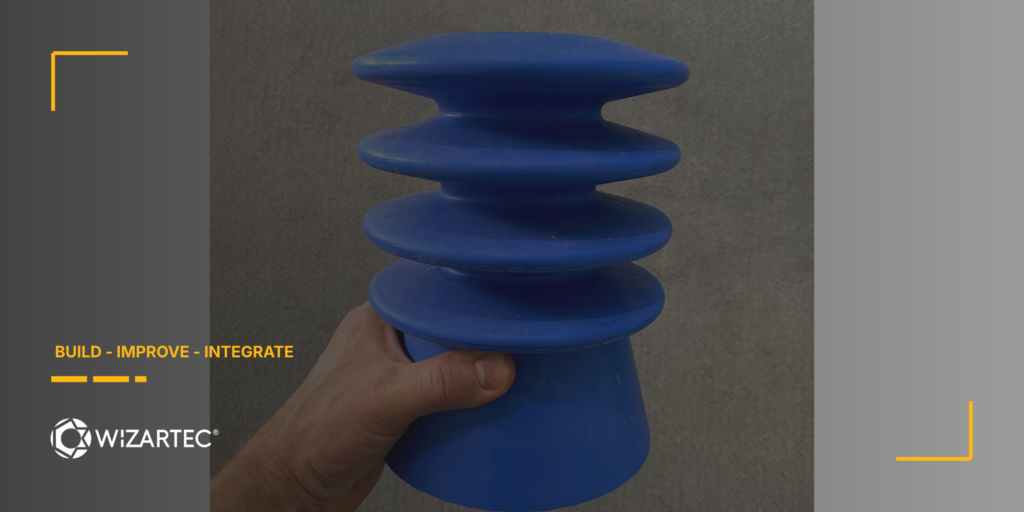
Put simply, a pigging system is a technology for recovering product residue from industrial pipelines. To understand how it works, think of a bore brush or a rubber window squeegee moving along the inside of a pipe and wiping its walls clean.
In engineering terms, the process involves moving a specially designed element, called a pig (also known as a pipeline pig or scraper), through the pipeline. The pig has a diameter slightly larger than that of the pipe, but thanks to its flexible surface, it adapts precisely to the pipe’s inner diameter. This tight fit, known as an interference fit, makes it possible to achieve a high rate of recovery of the product left on the pipe wall.
The operating cycle looks like this: when the transfer of a product (such as yoghurt, paint, shampoo, cream or meat slurry) comes to an end, a significant amount of valuable product is still left in the pipe. In a conventional process, it would be flushed down the drain with water. In a pigging system, a driving medium (most often compressed air, nitrogen, water or the next batch of product itself) is fed in behind the pig. The pressure of the medium pushes the pig through the pipeline, and the pig pushes the product ahead of it into the destination tank or filling machine. The pig then returns to the launch station (often after CIP cleaning), ready for the next cycle.
The key point is that pigging is not only used for cleaning (as its historical name, linked to removing deposits from oil pipelines, might suggest), but above all for recovering finished product that would otherwise become waste.
Key advantages and benefits (a fact-based analysis)
The benefits of implementing pigging systems are multi-dimensional. Below is an overview of more than 20 specific facts and advantages, grouped into four key categories: economics, the environment, process efficiency and quality.
1. Economics and savings (ROI)
- Direct product recovery: Pigging systems can recover up to 99.5% of the product left in the pipeline. For expensive products (such as pharmaceuticals, premium cosmetics or honey), the investment often pays back within a few months.
- Lower waste disposal costs: Less product in the wastewater means a drastic reduction in the costs of removing or treating it (industrial wastewater discharge fees).
- Lower consumption of cleaning media: Because the pipe is mechanically “wiped” before the actual cleaning, the water used for pre-rinsing drops almost to zero.
- Savings on cleaning chemicals: The CIP (Clean In Place) cycle is shorter and requires lower detergent concentrations, because most of the soil has already been removed physically.
- Using the product itself as the driving medium: In some configurations, the pig can be pushed by the next batch of product, which eliminates transition zones.
- Reduced material losses: Fewer start-up and end-of-run losses at every product changeover.
2. Environment and sustainability
- Lower COD and BOD levels: Chemical oxygen demand (COD) and biochemical oxygen demand (BOD) in the wastewater are significantly lower, which reduces the load on both on-site and municipal wastewater treatment plants.
- Smaller carbon footprint: Less waste to transport and less energy used to heat cleaning water translate into lower CO₂ emissions.
- Saving drinking water: The food industry uses enormous amounts of water. Pigging can save thousands of litres of water per year on a single line.
- Lower risk of hazardous substance leaks: In the chemical industry (e.g. with solvents), a closed recovery system is safer for the surrounding environment than conventional flushing.
3. Process (operational) efficiency
- Faster changeovers: The time needed to switch from producing product A to product B is shortened, because the pipeline is emptied in anywhere from several dozen seconds to a few minutes (depending on the pipeline length and the viscosity of the product).
- Greater production flexibility: Shorter runs can be produced without worrying about high losses at each product changeover.
- Less wear on pumps: The pig is driven by the driving medium (e.g. compressed air), so the product pumps are not loaded while the pipeline is being emptied.
- Dedicated pipelines become unnecessary: Instead of building separate lines for each flavour or colour, a single transfer line can be used safely for many products.
- Process automation: Modern systems are fully integrated with the plant’s control system, which eliminates human error associated with manual cleaning.
4. Quality and safety
- Eliminating cross-contamination: Thorough removal of residue minimises the risk that, for example, an allergen from the previous batch ends up in the next one.
- Less product aeration: Unlike blowing the line out with air alone, the pig forms a physical barrier between the driving gas and the product, which prevents foaming and oxidation.
- Hygienic design: Pigs and stations are usually designed in line with EHEDG guidelines or 3-A standards, which ensures there are no dead zones where bacteria could grow.
- Ongoing control of pipeline condition: Regular pig runs prevent a film of product from building up on the pipe walls, where it could harden or spoil over time.
- Worker safety: Less operator contact with aggressive cleaning agents and less need to dismantle pipes for manual cleaning.
Pigging system applications in industrial processes
Pigging systems are versatile, but they deliver their full potential in processes handling medium- and high-viscosity liquids. The main areas of application are:
- Food and beverage industry:
- Viscous preserves: jams, marmalades, tomato sauces, mayonnaise and mustard. These are expensive products that are hard to flush out, which makes them ideal candidates for pigging.
- Chocolate and confectionery: chocolate does not tolerate water. Pigging is essential here to empty pipelines without introducing moisture.
- Dairy: yoghurts, processed cheese, cream and ice cream.
- Beverages: fruit juices and concentrates, wines and syrups.
- Cosmetics and personal care industry:
- Production of shampoos, shower gels and conditioners (high-foaming products, where pigging eliminates foaming).
- Creams, lotions, toothpastes and mascaras (products with a very high market value per litre).
- Household and industrial chemicals:
- Paints, varnishes, resins, adhesives and silicones.
- Detergents, laundry liquids and fabric softeners.
- Petrochemical industry (lube oil):
- Oil and grease blending plants, where a single filling line handles dozens of different oil viscosity grades.
- Pet food production:
- Wet pet food (slurry), sauces and palatability enhancers.
The processes in which these systems are most often used are:
- Transfer from a mixer/reactor to buffer tanks.
- Transfer lines to filling machines (fillers).
- Road tanker unloading lines, on the section to …
Integration: inlet and outlet systems
The effectiveness of pigging depends on how well it is integrated with the surrounding process equipment. It is not a “bolt-on”, but an integral part of the pipeline.
Inlet integration (source): The system usually starts downstream of the product feed pump. Its key element is the launch station (launcher), which must be integrated with:
- Shut-off valves: The product source and the driving medium source (air/water) must be isolated from each other. Specialised ball or butterfly valves are used for this, including to feed in the driving medium.
- Valve manifolds (valve matrix): In modern plants, the pigging station is often located directly downstream of a valve matrix that routes product from multiple tanks into a single line. The control system must “know” when the route is open for the pig.
- Utility supply: Connection to the compressed air, nitrogen or water supply, with appropriate filtration and pressure regulation.
Outlet integration (destination): The system ends at the receiving station (receiver), which is usually located directly upstream of:
- The filling machine (filler): This is the most critical point. The pig must stop in the receiving station and allow the last portion of product to be pushed directly into the filling head without introducing air into the packaging.
- A storage tank: In the case of transfers between process stages.
Signal integration: The receiving station sends a signal to the PLC (for example via magnetic field sensors that detect the magnet in the pig) that the cycle is complete, which allows CIP cleaning to start or the pig to return.
Automation (PLC/SCADA): Pigging does not work in isolation. It has to be integrated with the higher-level control system. The valve opening sequence must be timed to the millisecond to avoid water hammer. Integration covers:
- Confirming that the pig is present in the station.
- Monitoring the driving medium pressure.
- Interlocking the pumps while the pig is travelling.
Other key technical considerations
When deciding to implement this technology, you need to pay attention to several technical details that determine whether the project succeeds or fails.
Pig design and material: This is the heart of the system. It cannot be just a piece of ordinary rubber. Industrial pigs are made from food-grade silicone, EPDM, FKM or polyurethane approved for food contact (FDA, Regulation (EC) No 1935/2004). Their design matters:
- Single-piece pigs: More hygienic, easier to clean and less likely to break apart.
- Pigs with replaceable seals: More commonly used in the chemical and fuel industries.
- Magnetic core: Most pigs have an embedded magnet, which allows them to be detected without contact in the pipeline by magnetic sensors. This enables precise process control and makes it possible to locate the pig in the event of a fault.
Pipeline geometry: A pigging system does not forgive installation mistakes.
- Bends instead of elbows: Bends with a suitable radius must be used so that the pig does not get stuck.
- Welds: They must be made by orbital welding or precisely ground on the inside (no weld beads protruding into the pipe).
- Constant diameter: No diameter reducers may be used in the section through which the pig travels.
- Special tees: Standard T-pieces are an obstacle for the pig (it can slip into the branch). Barred tees with guide bars or special piggable valves are used instead.
Pressure safety: Because the driving medium is often a compressed gas, the pipeline effectively becomes a pressure vessel. The launch and receiving stations must be depressurised according to set procedures before they are opened (e.g. to inspect the pig), to avoid the pig being dangerously “shot” out.
In summary, pigging is no longer a novelty but has become standard practice in modern process installation design. Investing in this system is not just an infrastructure cost, but a tool that directly improves a company’s bottom line by maximising production yield.
Pigging is a technology for recovering product from industrial pipelines. A flexible pig, most often driven by compressed air, nitrogen or water, pushes the product residue into a tank or filling machine. In some configurations, the pig is pushed by the next batch of product. As a result, product is not flushed into the wastewater, and the system can recover up to 99.5% of what is left in the pipe. Water used for pre-rinsing drops almost to zero, and CIP cleaning is shorter and uses less detergent. On top of that come shorter changeovers, a lower wastewater load and a lower risk of cross-contamination. The system’s effectiveness, however, depends on proper integration with the valves, the PLC/SCADA automation and the filling machine or destination tank. Construction details also matter: pipeline geometry, weld quality, pig material and pressure safety.


Cost-benefit assessment
Find out how much product you’re losing in your pipelines
We’ll analyse your installation and tell you whether pigging will pay off for you.