
Who this article is for:
- Technical directors and production managers planning technology investments
- Project managers responsible for the budget and schedule of an installation project
- CFOs and financial controllers preparing budget documentation for financing (loans, leasing)
- Investors and owners of manufacturing companies who decide whether to go ahead with an investment
What you will learn from this article:
- What budgeting a technology investment involves and how it differs from cost estimating
- Why a project’s feasibility cannot be assessed without a reliable budget
- What risks a project faces when its budget has been prepared carelessly
- How to prepare a realistic investment budget, step by step
Why we wrote this article:
- According to the AACE International classification for the process industries, a cost estimate made at an early stage, when there are only initial ideas or a rough outline of the concept, can deviate from the actual value of the investment by as much as −50% to +100%. We show how to match the level of detail and the structure of the budget to the project stage in order to reduce estimate uncertainty.
- Budget overruns rarely result from a single mistake. They are usually the sum of items that were missing from the first estimate. We explain how to plan costs so that your investment stays within its budget.
- Many projects are not completed on time. We describe how linking the budget to the schedule reduces the risk of delays.
- Budgets are often prepared by people without sufficient process engineering experience and know-how. The result: significant cost categories are overlooked. We point out the ones most often missed in initial pricing.
- Most budgets are set with an excessive margin. The surplus is then often artificially frozen or spent hastily at the end of the project, and part of the investment potential goes unused. We explain how to plan costs so that the budget neither has to be inflated nor understated.
- Investors send out requests for quotation before their concept is fully developed and receive offers that cannot be reliably compared. We advise on the right time to go out to tender and how to prepare for it.
Data sources
- Source: AACE International, Recommended Practice 18R-97, rev. 2020, https://web.aacei.org/docs/default-source/toc/toc_18r-97.pdf
What is budgeting a technology investment?
Budgeting an investment means estimating, planning and allocating the funds needed to deliver a project – from concept, through design and execution, to commissioning of the installation. A one-off cost estimate gives a figure valid on a specific date. A budget covers the entire project life cycle and takes into account that costs change over time.
The investment is broken down into cost categories: materials and equipment, labour, design costs, indirect costs and a contingency for unforeseen expenses. Each category is assigned a value based on market conditions and data from previous projects. The result is a document that both the investor and the contractor refer to throughout the delivery period.
Budgeting differs from cost estimating in that it does not end with pricing. It also involves continuously comparing actual spending against the plan and making adjustments when conditions change.
Why is budgeting a prerequisite for the feasibility of a process installation project?
Before execution begins, you need to know whether the investment will fit within the available funds. A reliable budget makes it possible to assess this at a point when changing the scope or dropping some of the assumptions still costs nothing. The same questions asked during installation already mean redesign, changes to orders or downtime.
A detailed cost estimate also becomes part of the contract between the project parties. It clearly defines what is included in the scope of work for a given price. This makes it easier to formally settle successive stages and narrows the room for contractual disputes. In process technology projects, such disputes most often stem from a vaguely defined scope, not from the technology itself.
A budget linked to project stages makes it possible to schedule payments according to actual progress, rather than relying on a single estimated figure set at the outset. This makes it easier to manage cash flow throughout the project.
Finally, only an itemised cost estimate provides a basis for reliably comparing offers from different contractors. Without a breakdown, you are comparing a single bottom-line figure that may cover a completely different scope of work. Choosing a delivery partner then stops being a data-driven decision.
What types of budget are used at different stages of an investment?
The level of detail in a budget should match the maturity of the project, meaning the decision-making stage the investor has reached. The better defined the process problem and the scope of the solution, the more accurate the cost estimate can be.
A highly detailed estimate at an early stage does not add much value. The opposite situation is more dangerous: an overly general budget adopted as the basis for a go-ahead decision is a real financial risk. If costs are underestimated, there may not be enough money to finish the work, and the capital already committed will be tied up in an unfinished installation. If they are overestimated, the company unnecessarily locks up funds it could use for other purposes.
In practice, we distinguish four types of budget, corresponding to successive stages of the investment. They differ in purpose, estimate accuracy and the scope of data on which they are based.
1. Rough budget estimate / cost range – problem identification stage
The investor is still identifying what is limiting their production process and does not yet have a concept for a solution. The right tool at this stage is a rough budget estimate, meaning a cost range. It indicates the scale of the capital expenditure and makes it possible to judge whether further work makes sense. Pricing a single specific solution is not justified at this stage: the investor does not yet know the available technologies and cannot judge which one best meets their needs.
2. Option-based budget estimate – concept stage
The problem has been defined and the expectations for the installation have been set out. The option-based budget estimate is now used to compare alternative technical solutions. A separate cost estimate is prepared for each concept under consideration, so the options can be assessed both technically and economically.
3. Detailed budget estimate – concept adaptation stage
The chosen concept has to be adapted to the conditions at the site: available space, existing infrastructure, utilities, regulatory requirements and scheduling constraints. At this stage, a detailed budget estimate is prepared, based on a defined scope of work and specific technical solutions. It forms the basis of the commercial offer, because it responds to the client’s specific enquiry.
4. Final budget – procurement stage
Even at the procurement stage, with the budget already approved, it is worth analysing alternatives: different equipment, suppliers or installation methods for individual components. Pricing these alternatives makes it possible to optimise costs within the approved budget without lowering the technical specifications of the installation. Negotiations also take place at this stage and further shape the final budget. The final budget forms the basis of the implementation proposal and the contract for carrying out the work or delivering the investment project.
| Situation | Investment stage | Budget type | What the investor gets | What the budget is for |
|---|---|---|---|---|
|
The investor knows the production process has limitations but does not yet have a concept for a solution |
Problem identification |
Rough budget estimate / cost range |
An estimated scale of capital expenditure |
Assessing whether it is worth continuing work on the investment |
|
The investor understands the problem and their expectations, and is considering several possible solutions |
Concept stage |
Option-based budget estimate |
A separate cost estimate for each concept |
Comparing solutions in technical and economic terms |
|
The investor has chosen a concept and wants to adapt it to the conditions at their plant |
Concept adaptation |
Detailed budget estimate |
A cost estimate based on a defined scope of work and specific solutions |
A reference point for design and execution |
|
The investor has an approved budget and is preparing for procurement |
Procurement stage |
Final budget with option pricing |
Pricing of alternative equipment, suppliers or installation methods |
Cost optimisation within the approved budget |
What risks does a process technology project face when its budget is not prepared reliably?
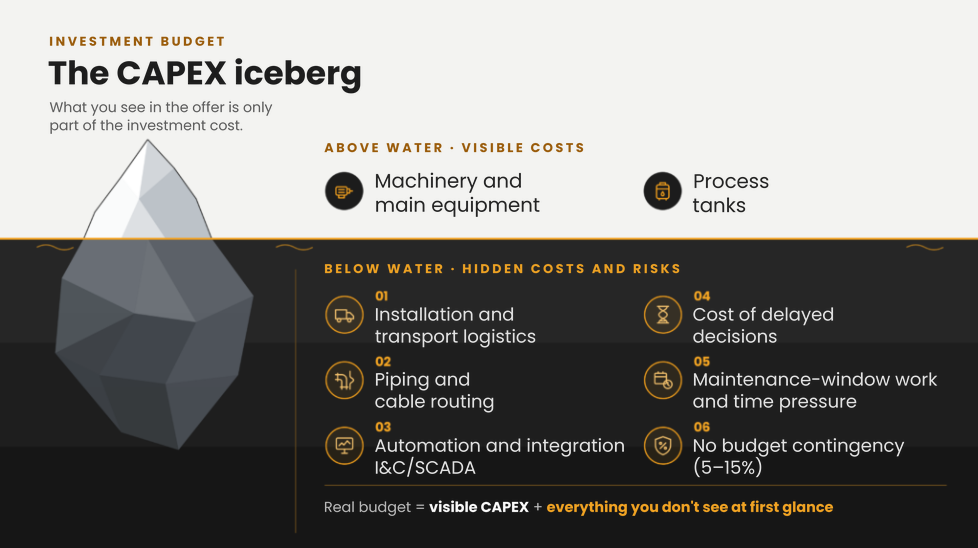
A poorly estimated budget is not a single risk, but several interlinked mechanisms that reinforce one another as the project progresses. Below, we break them down one by one.
1. Costs overlooked at the initial pricing stage
The price of the installation itself is sometimes treated as the full cost of the project. However, transport, component storage, welfare facilities for the installation crew, health and safety costs, the fees of designers and engineers, technical documentation, and testing and acceptance are all separate cost categories. The same applies to integrating automation and control systems: control cabinets, cabling, SCADA/MES licences and I/O checkout are often not included in the equipment price, and at the pricing stage nobody assigns them to a specific scope. If these items are missing from the original estimate, they surface during execution as additional expenses for which funds may not have been set aside.
2. No budget contingency
Every engineering project is exposed to unforeseen events: rising material prices, delivery delays, technical faults and regulatory changes. A budget contingency, typically set at 5–15% of the project value, protects against having to urgently seek additional financing during execution. Without it, the very first unforeseen event threatens the continuity of the investment’s funding.
3. Compounding delays
Building a process installation usually involves a sequence of interdependent stages. If one of them comes to a halt because funds have run out before it can be completed, the schedule for the entire investment slips. The installation starts up later and begins delivering its planned operational value later.
4. Decisions made under pressure instead of through analysis
If the budget is not precise enough, every deviation from the plan requires an immediate response. There is then no time to calmly compare solutions or negotiate better terms. Decisions are made under time pressure, and the more expensive option is usually chosen just to keep the work going.
5. Difficulty assessing and controlling project progress
Without a detailed budget as a reference point, it is difficult to verify whether the reported costs and progress are justified. When the cost estimate is revised during execution, it is hard to tell justified changes apart from inefficient project management. This weakens the investor’s negotiating position for subsequent payments.
6. Project suspension
In extreme cases, insufficient funds to complete the investment lead to work being suspended indefinitely. This means capital tied up in an installation that generates no operational value, and completing it after a break usually costs more than delivering it according to the original, realistically calculated budget.
How to prepare a realistic and effective budget: stages and best practices
A reliable budget is not created by estimating a single lump sum. It is built in several connected steps, from defining the project scope to ongoing budget control during execution.
1. Defining the project scope
Without a clearly defined goal and requirements for the process installation, it is impossible to plan a meaningful budget. The following questions need to be answered:
- Which technologies will be implemented?
- Which standards and regulations must be met?
- What are the space and infrastructure requirements?
- What result does the client want to achieve once the installation has been implemented and commissioned?
- Does the client have fixed time constraints for the project? (site access: working hours, weekends)
- Will other installation crews be working on site during the project?
2. Detailed cost estimating
An accurate cost estimate is the foundation of budgeting. It should cover:
- Materials and equipment costs: purchase, transport and storage of components.
- Labour costs: wages for employees and subcontractors, health and safety costs, welfare facilities.
- Design costs: fees for designers and engineers, preparation of technical documentation.
- Equipment hire costs: rental of installation and transport equipment, welding consumables.
Each category needs to be broken down in detail. A general line item such as “installation” is the easiest way to overlook significant expenses.
3. Indirect costs
- Project management costs: salaries of management staff, communication and administrative costs.
- Financial costs: bank guarantees, loan interest, costs of potential payment delays.
4. Contingency for unforeseen expenses
A budget contingency is typically planned at 5% to 15% of the total costs. It covers, among other things, price increases and delivery delays.
5. Risk management
The earlier risks are identified and assessed, the easier it is to stay within budget. This stage requires:
- Risk analysis: assessing threats such as regulatory changes, delays or technical problems.
- Preventive measures: rapid response procedures and contingency plans.
6. Regular budget monitoring
The budget needs to be regularly reviewed and updated. Systematically comparing actual costs against the assumptions makes it possible to catch deviations before they grow.
7. Flexibility in budgeting
Construction and process technology projects change during execution, so the budget has to allow for modifications. There is one condition: every change must be documented. Only then does the project’s financial position remain transparent.
Why work with WiZARTEC®
Each stage of an investment requires a different budget and different data to prepare it. That is why we tailor the way we work with you to your company’s situation, so that every financial decision is based on information that is right for that point in the project.
1. End-to-end service – budget control from concept to commissioning
We manage the entire investment process from start to finish under a “build, improve, integrate” model. With us, the budget goes through every stage: from rough, through option-based and detailed, to final. During execution, we continuously compare spending against the plan. Responsibility for delivery lies with us. As a system integrator, we want the installation to fulfil the purpose for which it is built, which is why we choose the optimal process together with you.
2. Consulting – before you spend money on solving the problem
When a problem arises in your production process, we analyse its causes and point out possible solutions along with approximate costs. You do not invest in a solution that fails to address the root cause, and you know the scale of the costs from the outset. Consulting is a separate service, so you keep complete freedom: you do not have to carry out the next stages with us.
3. Comprehensive audit – an indicative budget when you don’t know where to start
You are facing a problem or challenge, but you do not know its cause or how to solve it. In that case, we analyse your production process, infrastructure and existing assumptions. On this basis, we prepare an indicative budget that shows the scale of the necessary expenditure and helps you judge whether it is worth continuing.
4. Consulting and pre-engineering – checking whether the budget will be enough
You have defined needs and allocated funds. We check whether those funds will be enough to deliver the planned solution. We verify the technical and cost assumptions before design begins and point out costs that may have been overlooked. You know that you will not run out of money before the investment is complete, and that you are not tying up funds unnecessarily.
5. Concept development – option-based budget estimate and data for the detailed budget
You are considering several possible solutions. For each one, we develop a technical concept with a cost estimate. You compare the options in technical and economic terms, and once you have chosen one, you have all the data needed for the detailed budget.
You can start working with WiZARTEC® at any stage. The earlier you do, the greater our influence on the accuracy of the budget and the course of the entire investment.
1180 +
Projects completed
765+
million PLN in completed projects
236+
Clients worldwide
A reliable budget is a prerequisite for the feasibility of a process installation project. It makes it possible to assess the investment before funds are committed, reduces the risk of contractual disputes and secures the continuity of work when execution departs from the original assumptions. A poorly estimated budget means overlooked costs, delays and decisions made under time pressure, and in extreme cases a suspended project and tied-up capital.
A budget is not prepared once, at the start of the project. Its level of detail should match the stage of the investment: a rough budget estimate when identifying the problem, an option-based estimate for the concepts being compared, a detailed estimate for the chosen solution, and a final budget at the procurement stage. An overly general estimate used as the basis for decisions risks either a shortage of funds or locking them up unnecessarily. An overly detailed estimate prepared too early adds nothing.
Regardless of the stage, what matters is a structured approach: a precisely defined scope, a detailed cost estimate that includes indirect costs, a contingency for unforeseen expenses, risk management and ongoing budget monitoring during execution.

He has been delivering investment projects in the process industry for 20 years. He has followed the full engineering career path: from designing installations, through managing projects as a Project Manager, to building project delivery structures as Technical Director and co-founder of WiZARTEC®.
He currently heads the Proposals Department at iPS Team, integrating WiZARTEC® process engineering with iPS Control® industrial automation. In his estimates, he focuses on engineering budget discipline and complete preliminary assumptions – eliminating risks and identifying critical costs at the stage where the market most often overlooks them, thereby safeguarding the profitability of the entire project.